Research
Our laboratory explores the fundamental design principles governing molecular circuits at the multicellular level. We aim to learn how organisms maintain robustness within an environment yet remain plastic across different environments.
Our current research focuses on :
1. how the robustness of development emerges from the communication between cells, and
2. how phenotypic plasticity optimzes performance under starvation.
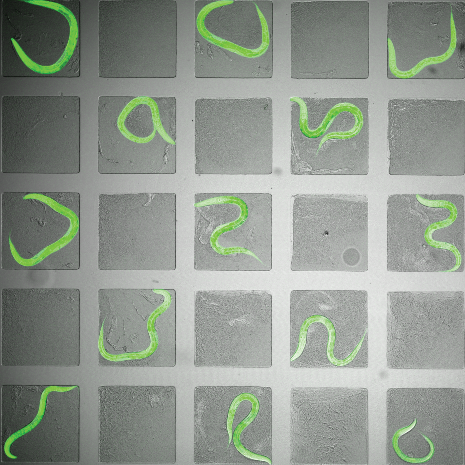
We employ a combination of quantitative experiments and computational approaches, using the nematode C. elegans as our model organism. Our technical strengths lie in in quantitative live imaging and computational image analysis, high-throughput screens, and in the precise spatio-temporal perturbation of molecular circuits.
1. Developmental Robustness: Orchestrating Cellular Growth
Key Question: How do an animal's cells coordinate their growth to consistently produce an appropriate body plan?
During development, organs grow exponentially by orders of magnitude. Therefore, small fluctuations in the growth rate can, in principle, amplify to significant size discrepancies. Yet, in nature, organ proportions are remarkably consistent across individuals. We investigate the molecular mechanisms that coordinate growth across different organs and thereby ensure this robustness.
References:
2023, Nature Communications
Maintenance of appropriate size scaling of the C. elegans pharynx by YAP-1
Klement Stojanovski, Ioana Gheorghe, Peter Lenart, Anne Lanjuin, William B Mair, Benjamin D Towbin
2022, Nature Communications
Coupling of growth rate and developmental tempo reduces body size heterogeneity in C. elegans
Klement Stojanovski, Helge Großhans & Benjamin D. Towbin

2. Developmental Plasticity: Thriving under Nutritional Fluctuations
Key Question: How do animals optimize their fitness in response to changing nutritional conditions?
Animals must navigate environments where food availability fluctuates. This requires a delicate balance between rapid growth during abundance and survival during scarcity. We investigate the molecular mechanisms that sense nutritional cues, how they alter gene expression, and how this regulation ultimately impacts organism-scale phenotypes, such as growth, reproduction, and aging. We thereby thrive to understand the molecular underpinnings of tradeoffs between these fundamental life history traits and how animals navigate these tradeoffs to make the best out of their environment.
Together, we aim to learn how organisms maintain robustness within an environment yet remain plastic across different environments.
References:
2026, PLOS Biology
Dietary restriction shapes intergenerational ribosome abundance and early growth of Caenorhabditis elegans offspring
Sigma Pradhan, Klement Stojanovski, Ferdinand Dellemann, Sacha Psalmon, Joel Tuomaala, Nicholas Stroustrup, Benjamin D Towbin
2026, bioRxiv
Autophagy-dependent proteome remodelling and ribosome decline balance starvation survival and recovery speed in C. elegans
Joel Tuomaala, Devanarayanan Siva Sankar, Julie Perey, Sacha Psalmon, Nicholas Stroustrup, Joern Dengjel, Benjamin D. Towbin